
5-LED or 6-LED dental light? Compare CL105 and CL106 by the job
Compare verified CL105 and CL106 head specifications, with CL108A as an eight-LED reference, and identify the evidence still needed before ordering.
Start with the answer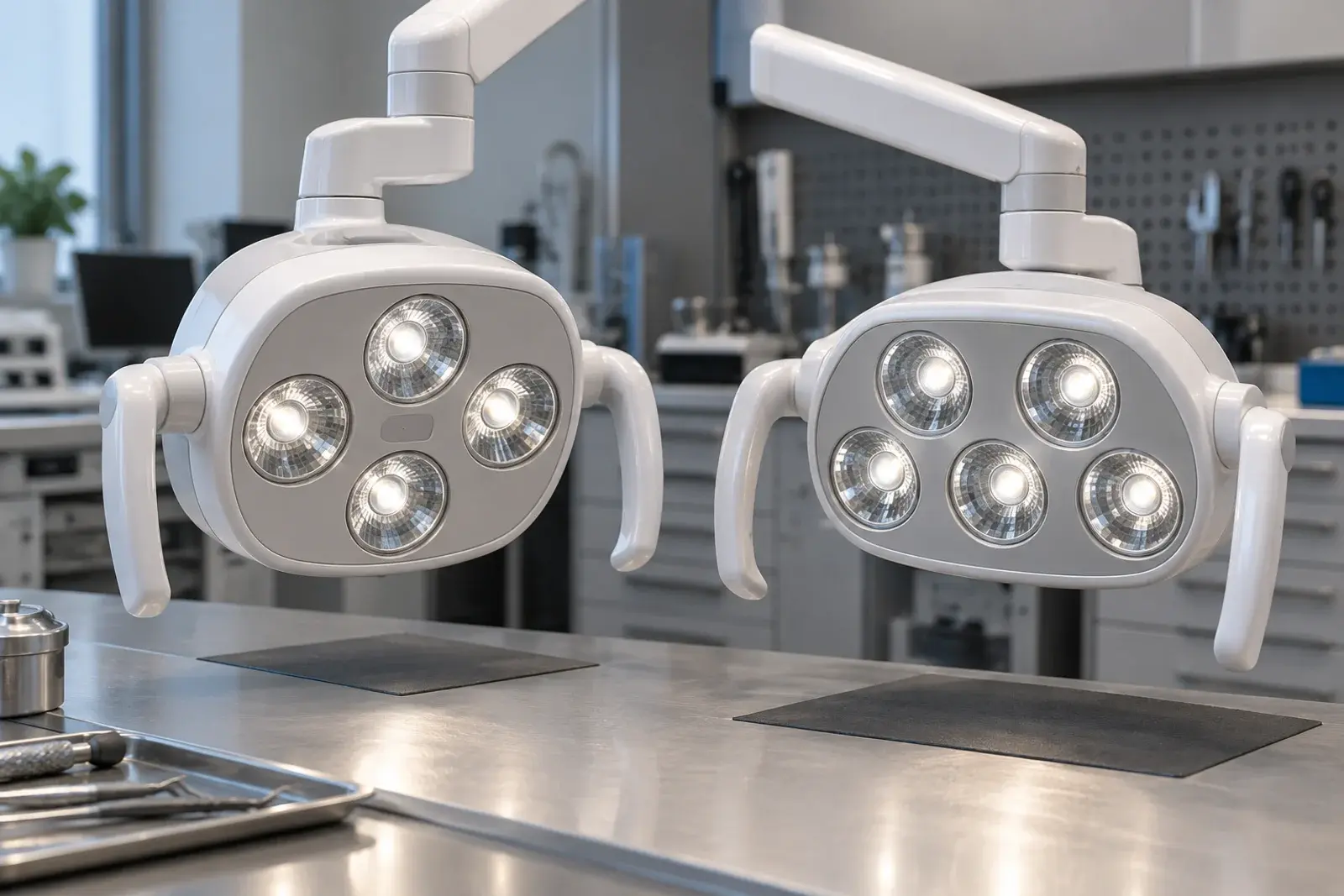
The buying decision, clearly stated.
Choose between CL105 and CL106 using the required controls, confirmed interface and an agreed sample evaluation, not LED count alone. The source sheet lists CL105 at 20,000–60,000 lux and 16 W, and CL106 at 22,000–68,000 lux and 18 W. Measurement distance is not supplied, so these are catalogue ranges rather than a normalized performance test.
- CL105 has five LEDs; CL106 has six. Neither count establishes beam quality by itself.
- Both list memory, a brightness indicator and sensor/manual adjustment; verify the actual supplied configuration.
- CL108A is an eight-LED reference with different listed controls, not an automatic upgrade for every project.
What LED count tells you—and what it leaves open
LED count describes one part of the optical construction. The reflector or lens design, emitter characteristics, aiming, drive conditions and intended working geometry also influence the resulting field. A higher count does not independently prove better uniformity, lower glare, more useful shadows or improved clinical outcomes. Ask the evaluator to identify a practical problem that the different head must solve.
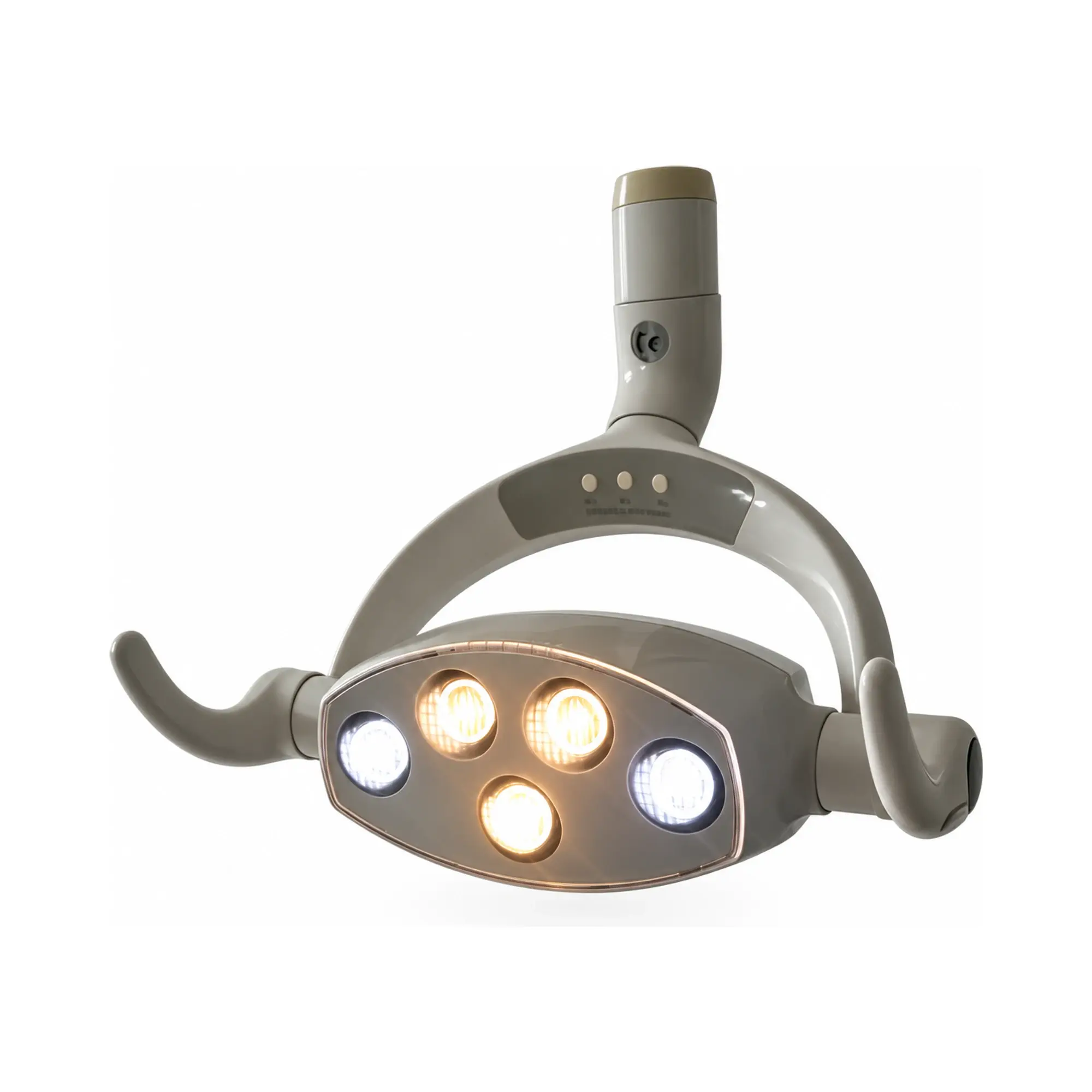
The Colight parameter record identifies CL105 as a five-LED head and CL106 as a six-LED head. Keep that identity with the model, not a loose marketing phrase. Some historical image-folder names differ from the verified model mapping; current model pages and source-sheet joins are the reference for ordering, rather than guessing the name from a filename.
Read the listed values with their limits attached
The values in this guide come from the site's reconciled manufacturer parameter catalogue. They refer to lamp heads. They do not establish the power consumption, mass, stability or electrical conformity of an entire chair, arm or mobile system. A complete installation must have its own confirmed scope and documentation.
CL105 and CL108A both list a 20,000–60,000 lux range, while CL106 lists 22,000–68,000 lux. Because the source does not state the measurement distance, these numbers cannot be used to calculate a fair brightness advantage at the treatment position. An established manufacturer's publication may state its own geometry; that does not supply missing geometry for a different manufacturer's lamp.
Evidence context: A-dec
Compare the operator tasks rather than feature totals
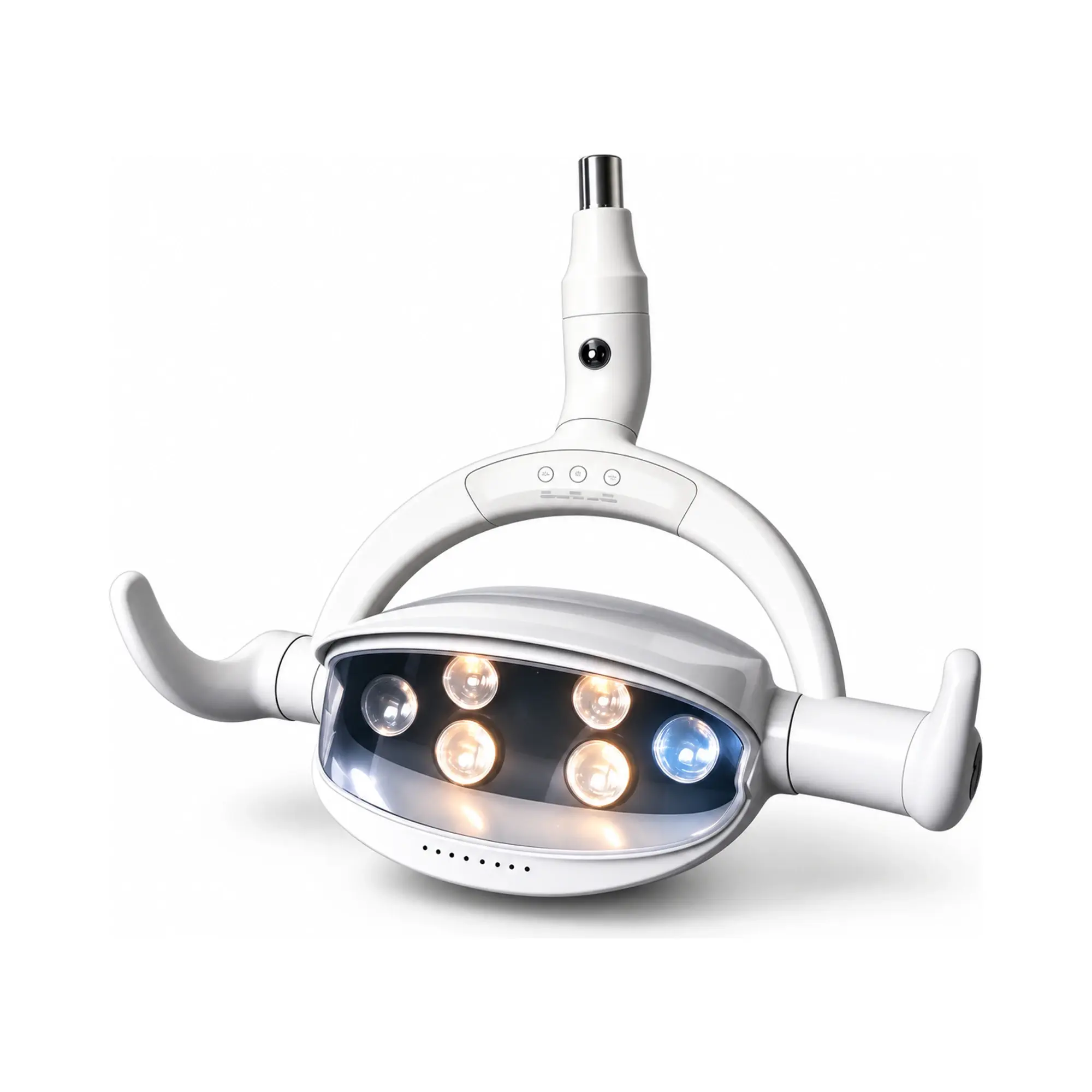
The CL105 and CL106 records list brightness memory, a brightness indicator, smart cooling and sensor/manual adjustment. Their listed colour settings are 3000 K, 4000 K and 5500 K. CL108A lists sensor/manual adjustment, smart cooling and adjustable joint tension, but the same source does not document the same memory and indicator features. An absent field is not proof a feature is impossible; it is a question requiring confirmation.
During the sample review, ask the operator to set brightness, switch the confirmed mode, reposition the head, move a gloved hand near the sensor and retrieve the intended setting. Record the control arrangement and behaviour observed. A feature that is present but awkward in the intended installation may be less useful than a simpler, well-understood configuration.
Close the gaps before creating a buying recommendation
All three heads list 12–24 V AC input and 22 mm or 26 mm connector options. Neither the voltage range nor nominal connector diameter proves fit with the buyer's chair. Check power-source type, available capacity, mechanical engagement, cable exit, arm loading and operation as an assembled system. Use the integration guide linked below to capture those fields.
ISO published ISO 9680:2026 in May 2026. Its existence is a reason to ask what standard edition and test scope an offered report addresses; it does not convert catalogue values into independently verified compliance. Request model-specific evidence and destination review where required, and keep any unresolved condition out of the sales claim.
Evidence context: ISO
A useful comparison question for each candidate
Qualitative decision cards complement the source values below; no model wins without the project requirements.
CL105 · five-LED head
- Useful for
- Listed memory, brightness indicator and sensor/manual controls in a 16 W head.
- Check carefully
- Working-distance information and complete installation compatibility still need confirmation.
- Decision context
- A sample brief that specifically requires the documented control functions.
CL106 · six-LED head
- Useful for
- Listed memory and indicator with an 18 W head and a different published illuminance range.
- Check carefully
- The larger maximum catalogue number is not a same-distance test result.
- Decision context
- A project that will evaluate the actual field and controls against an agreed acceptance record.
Put the evidence beside the decision.
| Field | CL105 | CL106 | CL108A |
|---|---|---|---|
| LED count | 5 | 6 | 8 |
| Listed illuminance | 20,000–60,000 lux | 22,000–68,000 lux | 20,000–60,000 lux |
| Rated head power | 16 W | 18 W | 35 W |
| Listed colour settings | 3000 K / 4000 K / 5500 K | 3000 K / 4000 K / 5500 K | 3000 K / 4000 K / 5500 K |
| Memory / indicator | Listed / listed | Listed / listed | Not stated / not stated |
| Input | 12–24 V AC | 12–24 V AC | 12–24 V AC |
| Connector options | 22 mm or 26 mm | 22 mm or 26 mm | 22 mm or 26 mm |
Approve a model without relying on the LED count
- 01
Define the task
Name the control, positioning and installation problem to solve.
- 02
Check the record
Use the verified model page and list absent test conditions explicitly.
- 03
Match interfaces
Confirm supply, connector, cable and the complete mounting assembly.
- 04
Evaluate samples
Compare at agreed geometry and control settings, recording the method.
- 05
Freeze configuration
Link the accepted sample and unresolved limitations to the quotation.
Worked example: a higher lux maximum is not the acceptance criterion
A hypothetical chair OEM is deciding between CL105 and CL106. Its actual requirement is repeatable brightness selection, clearance above the chair and a fit with the existing arm interface. Both model records provide relevant control information, but the OEM still needs the sample geometry and electrical review. The project cannot be approved from the published maximum lux values alone.
The evaluator defines a common working position and documents settings before observing both samples. If a candidate meets the agreed field, control and mechanical requirements, that result belongs to the tested configuration. It does not become a claim that every six-LED head is superior to every five-LED head. Keep any additional measured results with the method and sample identity, rather than silently inserting them into the manufacturer's catalogue specifications.
Questions buyers ask next.
Is CL106 automatically better because it has six LEDs?
No. The listed LED count and illuminance range are useful identifiers, but the appropriate choice depends on field behaviour, controls, installation and confirmed evidence for the intended use. There is no normalized comparison test in the source sheet.
Does the table prove compliance with ISO 9680:2026?
No. A catalogue table is not a test report. Obtain applicable evidence for the exact model, revision, configuration and standard edition, and assess the destination requirements separately.
Do these heads accept both AC and DC?
The verified source specifies 12–24 V AC. This guide does not state DC compatibility. Have the responsible engineer confirm the actual power source and supplied configuration before installation.
Can I use the head power to specify a mobile light system?
Not by itself. Head values do not establish the complete stand, arm, supply or wiring requirements. Request documentation for the assembled mobile configuration and its intended environment.
Follow the evidence.
Manufacturer and institutional sources inform the context. Colight specifications come from the verified site catalogue; competitor values are not presented as Colight test results. References were checked on 2026-10-27.
- ISO 9680:2026 — Dentistry: Operating lights
Edition and scope reference; the full standard is not reproduced. Publication: May 2026. Checked October 27, 2026.
- A-dec 500 LED dental light — manufacturer information
Industry reference for how an established manufacturer documents optical conditions, control modes and compatibility. Checked October 27, 2026.
Corrections or missing project evidence: contact Colight. The page supports purchasing discussions and does not provide patient-specific care, electrical installation instructions or a legal market-access decision.