
Dental-light lux, colour temperature and working distance: compare like with like
Use a comparison-validity checklist to separate catalogue numbers, missing measurement conditions and observations from an actual dental-light sample.
Start with the answer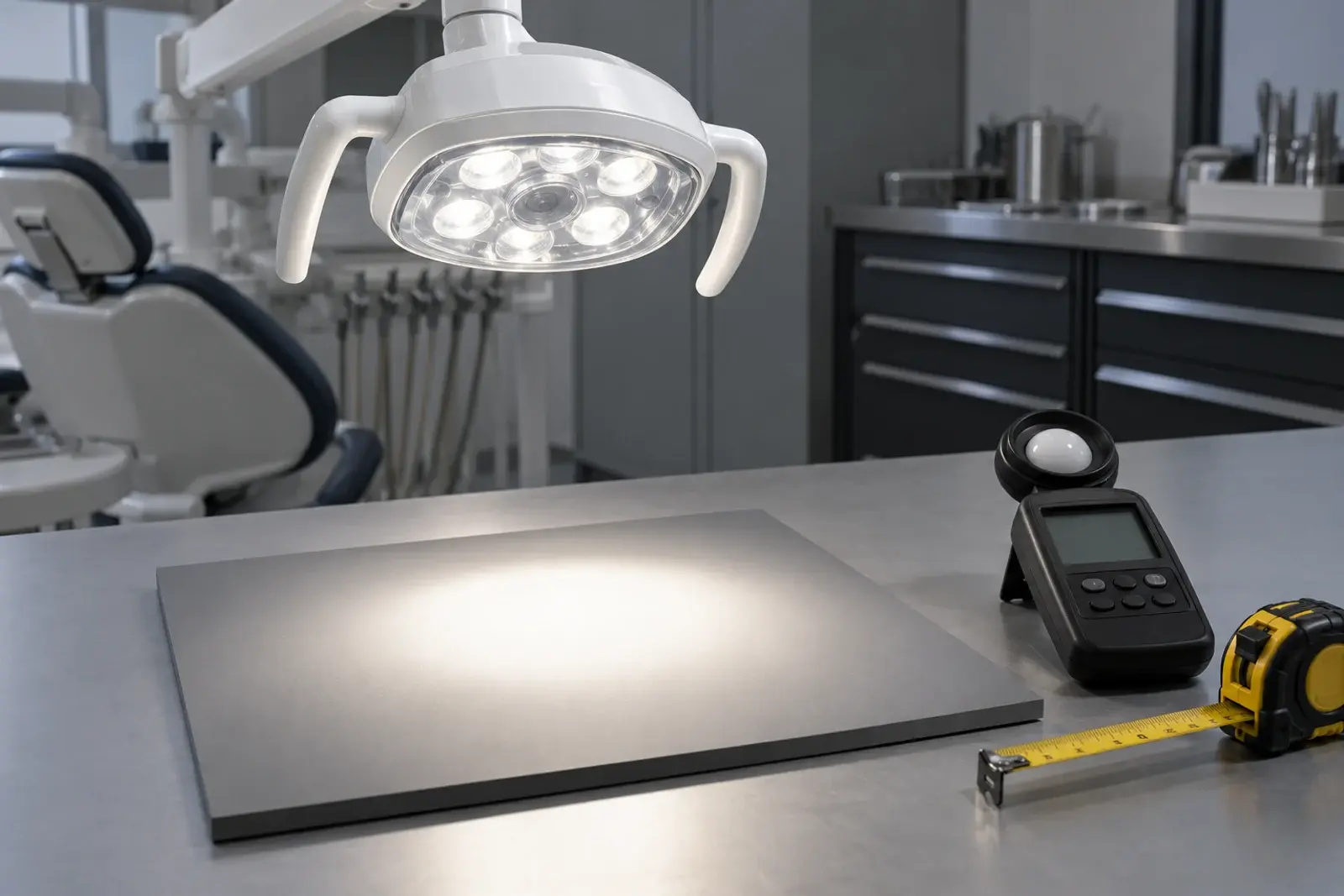
The buying decision, clearly stated.
Lux describes illuminance at a specified location, while colour temperature describes the appearance of the light; neither replaces a field evaluation. Compare lamps only after matching distance, measurement position, settings and test method. Colight's current source sheet does not supply illuminance measurement distance or CRI, so those fields must stay unconfirmed until relevant evidence is provided.
- Record geometry and settings before interpreting a lux value.
- Separate colour appearance, colour rendering, field behaviour and photobiological evidence.
- Do not fill a missing CRI or working distance using data from another manufacturer's lamp.
A lux number needs a location and a method
A catalogue range describes the manufacturer's stated output under conditions that may or may not be fully disclosed. It is not a map of the entire treatment field. A central reading, an edge reading and a reading at another position answer different questions. Keep the sensor position, lamp orientation, working distance, brightness setting, ambient lighting and instrument identity with any measurement you commission.
The current Colight table does not state a measurement distance. Mark that field not supplied instead of assuming a commonly used industry distance. A-dec's public light information is a useful example of a manufacturer attaching geometry to its own light pattern; those conditions cannot be transferred to Colight or used to normalize an unrelated product automatically.
Evidence context: A-dec
Colour temperature is not a substitute for colour-rendering evidence
Colour temperature is a way to describe a light's colour appearance. A warmer or cooler setting does not, by itself, establish how faithfully individual colours appear under that light. Colour-rendering measures concern a different aspect of performance, and their values need a source and a defined method. Do not translate a neutral-white product photograph into a CRI claim.
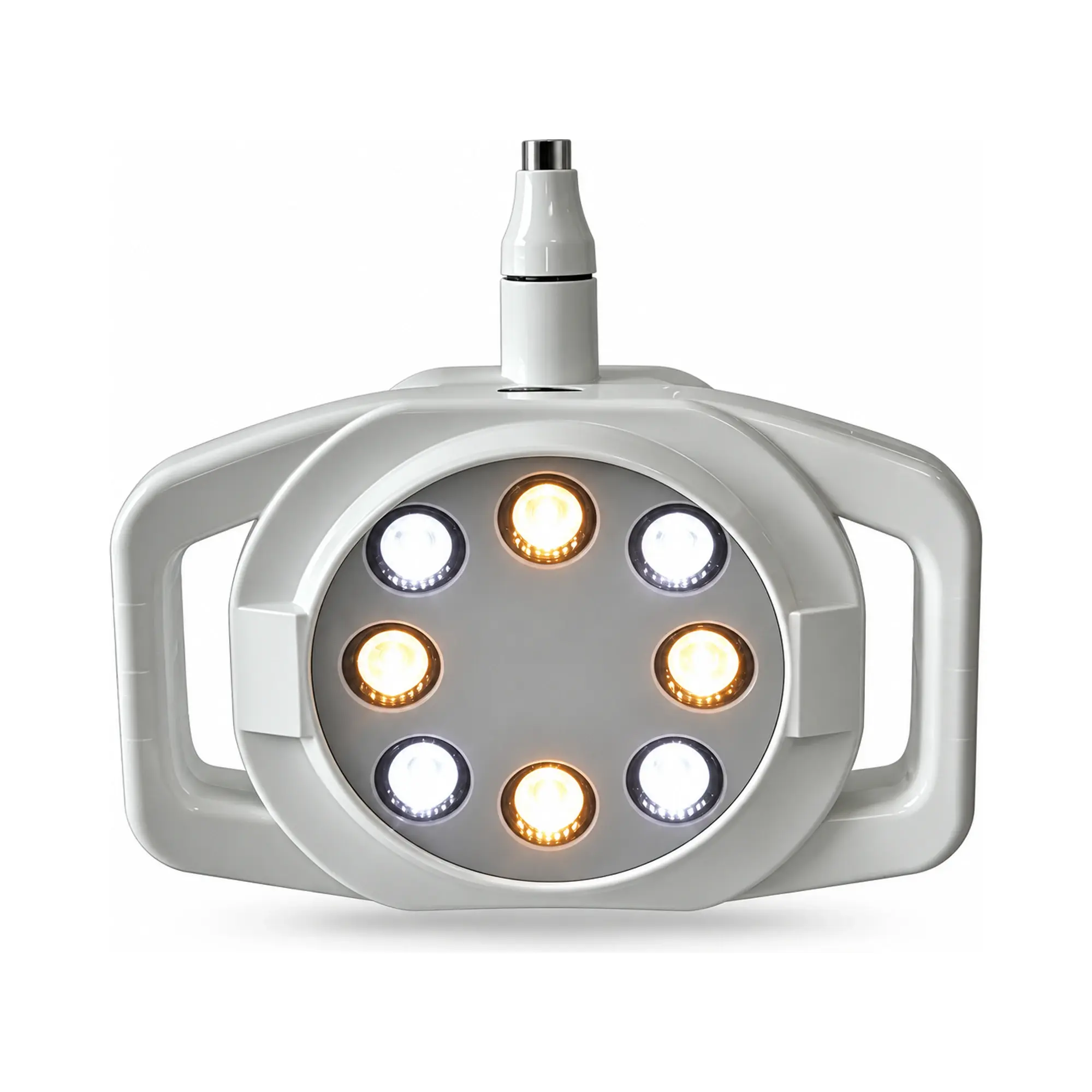
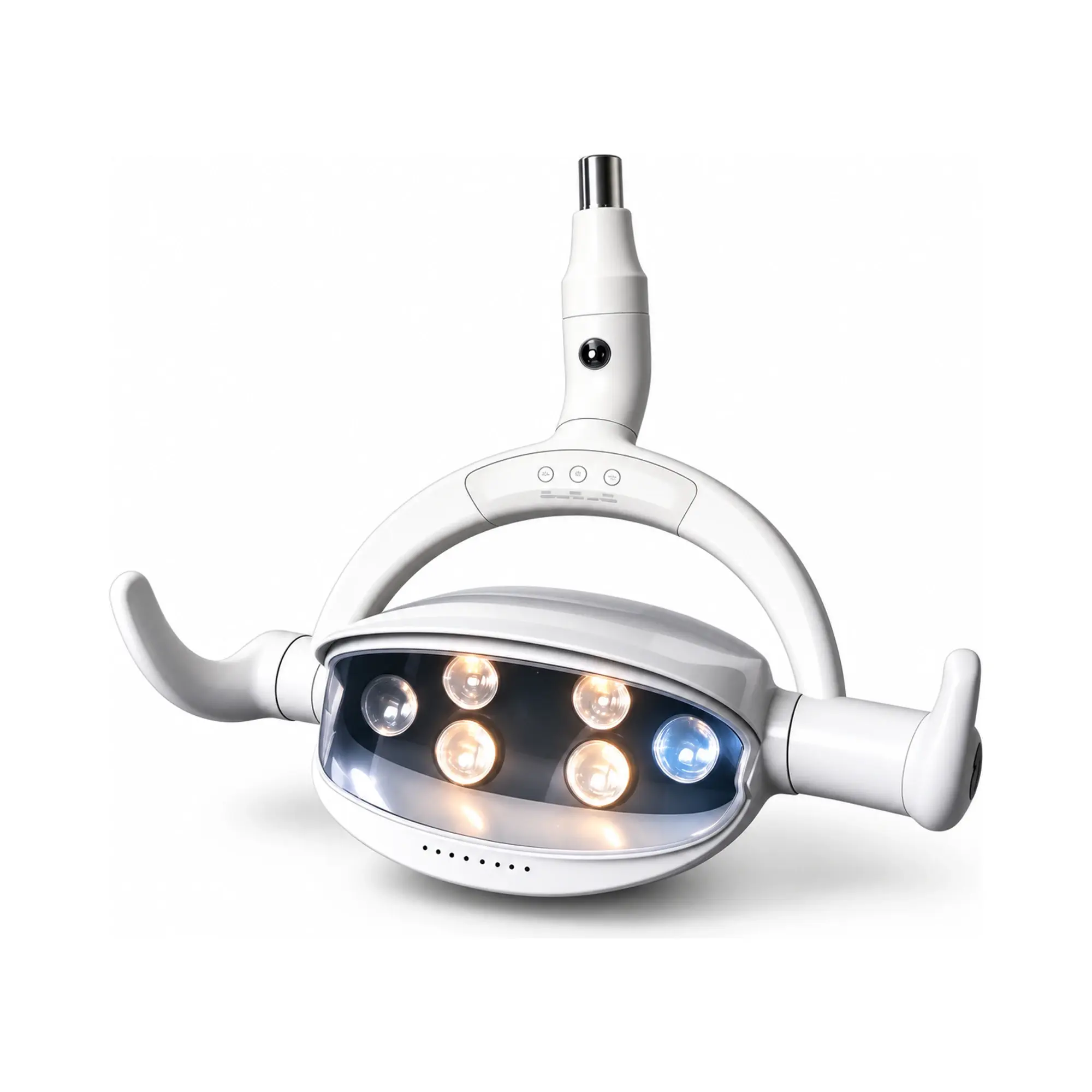
Selected Colight model records list 3000 K, 4000 K and 5500 K. What those entries mean operationally depends on the model: some describe settings, while others are configuration choices requiring confirmation. In particular, the listed CX104 and CX106 temperature values do not establish three switchable modes. A buyer comparing operation should ask what the delivered control actually changes.
Evaluate the useful field, shadows and positioning together
A lamp can look bright on a flat surface yet be inconvenient when the operator changes position. Ask evaluators to describe where the useful field is needed, how the head is positioned and which normal movements should be rehearsed. Record visible interruptions or adjustment difficulties as observations under the agreed conditions, not as universal diagnoses of the optical design.
Distinguish an informal demonstration from a standards test. A practical sample review can reveal unmet workflow needs, but it does not certify uniformity, eye safety or conformity. If the purchasing brief requires a formal result, define the applicable standard, edition, laboratory competence, test configuration and report coverage with the responsible technical team. Never rebrand a visual inspection as independent optical testing.
Use the current standard as a document question
ISO's public record shows ISO 9680:2026 replacing the 2021 edition. Request the edition behind any offered report. This guide does not reproduce requirements or thresholds from the paid standard, and a newer publication date does not tell the buyer which transition or destination obligations apply to a particular shipment.
A useful evidence request separates supplied catalogue values, observed sample behaviour, laboratory findings and unresolved fields. For Colight, leave CRI, flicker and unprovided optical test conditions open rather than assigning attractive values. The objective is a decision that can be checked later: which configuration was assessed, under which conditions, by whom and against what acceptance criteria.
Evidence context: ISO
A catalogue comparison versus a controlled evaluation
Both have a role, provided the conclusion stays within the available evidence.
Catalogue shortlist
- Useful for
- Efficiently screens model identity, listed ranges, power and documented controls.
- Check carefully
- Different or absent test conditions can make numerical rankings misleading.
- Decision context
- Selecting candidates and writing the missing-evidence request.
Agreed sample evaluation
- Useful for
- Records the actual configuration, geometry and operator tasks being assessed.
- Check carefully
- A local demonstration is not automatically an accredited standards test.
- Decision context
- Accepting a specific configuration or deciding which formal tests are needed.
Put the evidence beside the decision.
| Field | Record with the result | If absent |
|---|---|---|
| Illuminance | Location, distance, setting and method | Do not rank unlike catalogue readings |
| Colour temperature | Setting or ordered configuration and source | Ask whether it is switchable |
| Colour rendering | Named metric, method and report | Do not infer CRI from appearance |
| Useful field | Position, area and evaluation conditions | Request a repeatable demonstration |
| Safety or compliance | Exact model, standard edition and applicable report | Keep the claim unconfirmed |
Create a repeatable optical review
- 01
Specify the decision
Identify the task, working positions and evidence required.
- 02
Identify the sample
Record model, revision, supply and control configuration.
- 03
Fix the conditions
Agree geometry, ambient conditions and instrument method.
- 04
Record separately
Keep measurements, observations and unprovided values distinct.
- 05
Resolve or escalate
Request formal evidence when the acceptance brief depends on it.
Worked example: two quoted lux ranges with different evidence
A project buyer receives one quotation with a maximum lux value and a stated measurement geometry, and another with a range but no distance. The buyer should not divide the two numbers to claim a performance difference. The first decision is whether both suppliers can provide comparable conditions or samples for an agreed evaluation.
The comparison sheet records the missing distance as an evidence gap and adds a separate operational check for field placement and controls. If the supplier later supplies a report, the buyer checks that it applies to the same model and configuration rather than replacing the gap with an unrelated family value. If the gap remains, the recommendation must say so. A transparent incomplete comparison is more useful than a precise-looking ranking built on assumptions.
Questions buyers ask next.
What is the best lux value for every dental light?
There is no universal buying answer from a maximum catalogue number alone. Define intended use, working geometry, adjustable settings and required evidence, then assess the actual configuration under relevant conditions.
Can colour temperature tell me the CRI?
No. Colour appearance and colour rendering describe different properties. The current Colight source sheet does not provide CRI, and this guide does not assign a value by analogy with another light.
Can I assume a standard working distance for the Colight lux ranges?
No. The source sheet does not state the illuminance measurement distance. Ask for the applicable method or arrange an agreed evaluation instead of inserting an assumed distance into quotations or comparison tables.
Does a sample demonstration replace a laboratory report?
No. A demonstration supports a practical acceptance decision for the observed conditions. Formal compliance and safety claims require applicable evidence with the correct scope, method, edition and product identity.
Follow the evidence.
Manufacturer and institutional sources inform the context. Colight specifications come from the verified site catalogue; competitor values are not presented as Colight test results. References were checked on 2026-10-27.
- ISO 9680:2026 — Dentistry: Operating lights
Edition and scope reference; the full standard is not reproduced. Publication: May 2026. Checked October 27, 2026.
- A-dec 500 LED dental light — manufacturer information
Industry reference for how an established manufacturer documents optical conditions, control modes and compatibility. Checked October 27, 2026.
Corrections or missing project evidence: contact Colight. The page supports purchasing discussions and does not provide patient-specific care, electrical installation instructions or a legal market-access decision.