
Yellow mode on a dental operating light: what buyers should verify
Separate colour temperature, a confirmed composite mode and a curing device, then specify the control behaviour your clinical evaluators need to assess.
Start with the answer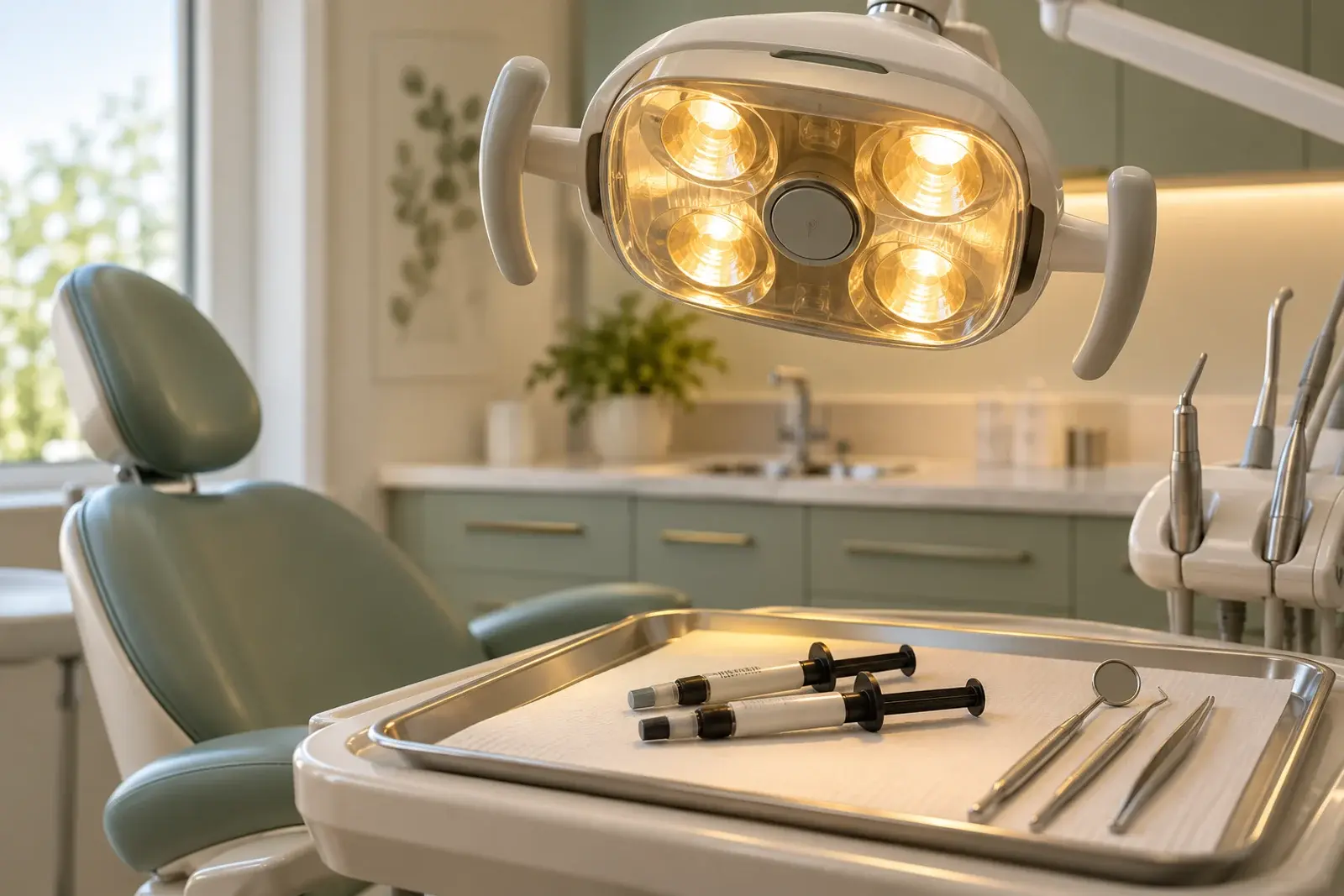
The buying decision, clearly stated.
A yellow appearance or a listed warm colour temperature does not, by itself, establish a composite-safe mode or a guaranteed working time. Confirm what the specific lamp mode changes, how the operator selects it and what evidence supports its intended use. Follow the restorative material instructions; an operating light does not replace the separate curing device.
- Write the required function in the RFQ instead of relying on the word dual-colour.
- Check the delivered control sequence and whether the intended setting is recoverable during normal operation.
- Never infer a curing delay from a photograph, colour-temperature entry or another brand's feature description.
Three descriptions that should not be merged
Colour temperature describes the apparent colour of light. A mode intended for working with light-sensitive restorative materials concerns a particular operating condition and its supporting evidence. A curing light is a separate device designed for a different task. Treat those descriptions as separate purchasing fields so that a sales phrase cannot silently become a clinical performance promise.
Dentsply Sirona describes blue-component reduction for its own LEDview Plus composite mode. That is a model-specific manufacturer explanation, not a specification for Colight. It illustrates the kind of functional explanation worth requesting: what changes, in which mode, under which documented conditions. Do not copy another manufacturer's mode name, spectral claim or working-time statement into a Colight quotation.
Evidence context: Dentsply Sirona
Check what the Colight record actually establishes
Selected CL records document colour settings, brightness memory and sensor/manual adjustment. Other models use a simpler control description or list temperature configuration options. CX104 and CX106 are examples where a list of temperature values must not be presented as proof of three switchable modes. CX106A has a selectable four-white-LED arrangement in its source description, with the final colour and switching configuration to be confirmed.
Ask the supplier to identify the ordered model, control hardware, selectable states and instructions. If a specific pure-yellow mode is essential, record it as a requirement awaiting confirmation for the proposed configuration. Do not assume every Colight lamp includes it merely because the company introduction mentions available features across a broader range.
Rehearse the controls as the evaluator will use them
An operating sequence can fail in practice without a component being defective. The sensor may be placed differently from the previous lamp; a gesture may be confused with switching brightness; a restored setting may not be the mode the evaluator expected. The sample brief should define the tasks to demonstrate and document the actual response, rather than asking whether the lamp feels convenient.
Have the clinical evaluator use the delivered instructions to identify the selected state, change modes, adjust brightness, reposition the head and return to the required condition. Record whether normal repositioning or nearby movement causes an unexpected response. Test only within the supplied operating instructions. If a control state is ambiguous, resolve the instructions or configuration before accepting the sample.
Keep material and compliance evidence separate
A purchasing article should not prescribe exposure times or promise that a restorative material will remain workable for a set duration. Material formulations, light conditions and manufacturer instructions differ. If a clinical team needs material-specific compatibility evidence, define the proposed evaluation with qualified personnel and retain its limitations. Do not generalize an observation to every resin, shade, distance or brightness setting.
A-dec also documents a dedicated setting on its own lamp, showing that this is a defined product function rather than a generic consequence of LED technology. Review source descriptions respectfully and use them to improve the questions in your brief. The resulting Colight buying decision still rests on Colight's confirmed configuration and appropriate evidence.
Evidence context: A-dec
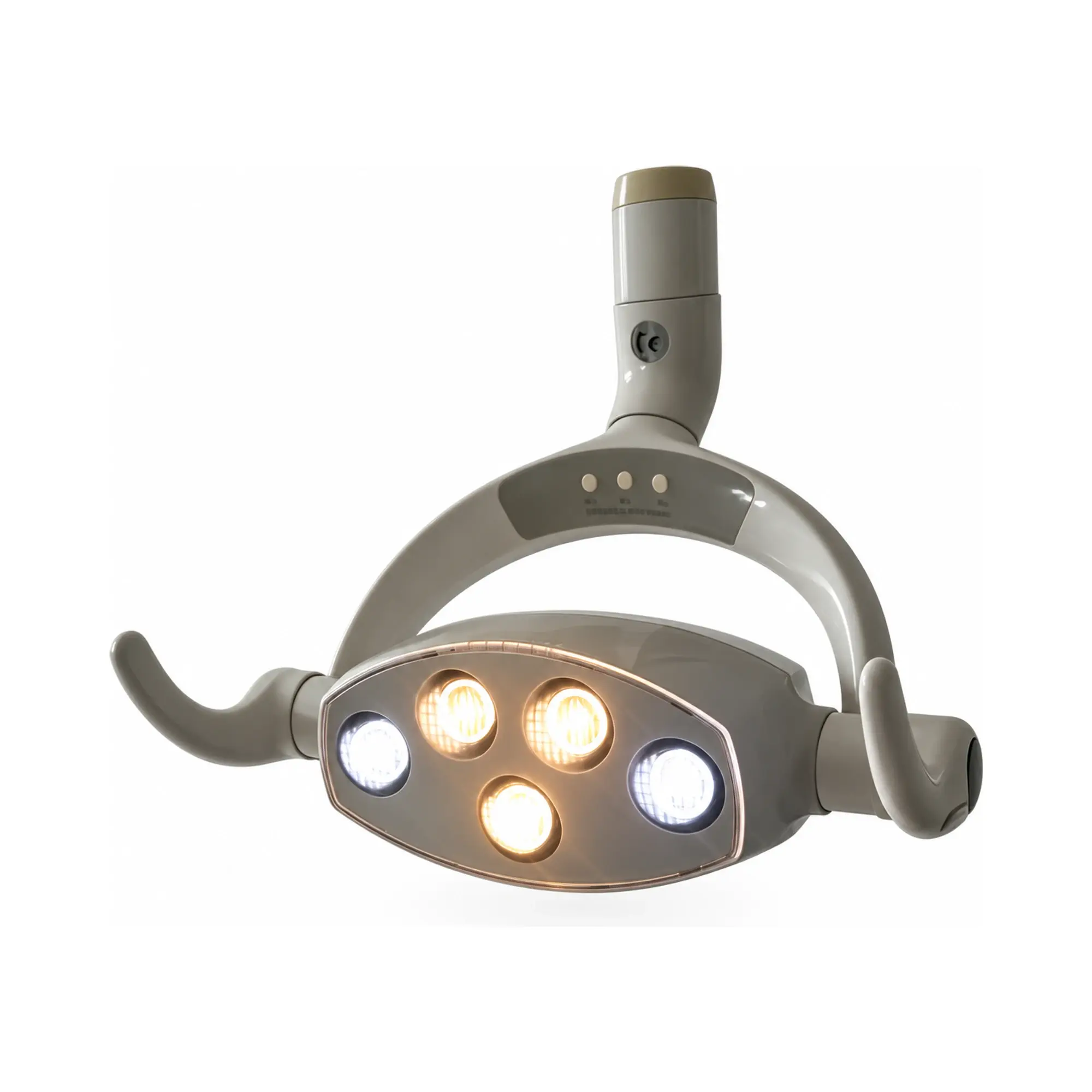
Colour appearance versus a documented operating function
The distinction prevents an attractive sales description from becoming an unsupported claim.
Warm-looking or yellow-looking light
- Useful for
- Provides an observable colour appearance to discuss with the evaluator.
- Check carefully
- Does not establish spectral filtering, material compatibility or a safe working time.
- Decision context
- Describing appearance while requesting the missing functional evidence.
Confirmed mode for the ordered configuration
- Useful for
- Defines a selectable function, control sequence and applicable instructions.
- Check carefully
- Any performance claim still needs evidence and stays within the specified conditions.
- Decision context
- A requirement that must be demonstrated during sample approval.
Put the evidence beside the decision.
| Question | Useful evidence | Do not assume |
|---|---|---|
| What changes in this mode? | Model-specific functional description | Warm appearance proves spectral filtering |
| How is the state selected? | Instructions and actual control demonstration | Every sensor uses the same gesture |
| Which options are included? | Quotation and configuration identifier | A temperature list means switchable settings |
| What materials were assessed? | Applicable evidence and material instructions | One material represents every composite |
| What is remembered? | Observed power and mode behaviour within the IFU | Brightness memory also stores every mode |
Approve the function before making the sales claim
- 01
Describe the task
State why the operator needs the mode and how it will be used.
- 02
Confirm the configuration
Identify selectable states and the ordered controls.
- 03
Check the instructions
Separate lamp guidance from restorative material and curing-device guidance.
- 04
Rehearse operation
Record the evaluator's control sequence and observed response.
- 05
Limit the claim
Publish only the function and conditions actually supported.
Worked example: a distributor asked for a composite-safe lamp
A hypothetical dealer receives a request for a composite-safe replacement light. The dealer should not answer by selecting the warmest listed colour temperature. The enquiry is rewritten as a function request: identify the confirmed mode, its selection method, its supporting documentation and the dental team's material-specific requirements.
If the proposed configuration only has a white-light setting with temperature options, the gap is stated before a sample is shipped. If a suitable mode is confirmed, the evaluator checks operation against the supplied instructions and records the accepted configuration. A claimed number of extra working seconds is excluded unless appropriate evidence actually supports it for the specified conditions. This keeps the conversation useful without promising a material outcome from the lamp's colour alone.
Questions buyers ask next.
Does 3000 K mean a dental light is composite-safe?
No. Colour temperature alone does not establish spectral behaviour or a restorative material working time. Ask for a model-specific mode description and supporting evidence, and follow the material manufacturer's instructions.
Do all Colight models offer a pure-yellow mode?
This guide makes no range-wide claim. The available function must be confirmed for the exact model and ordered configuration. Temperature options, selectable LED arrangements and dedicated modes are different fields.
Can the operating lamp cure the restoration instead?
Do not use this buying guide to substitute an operating lamp for the prescribed curing device. Those devices serve different purposes; the clinical team must follow the applicable device and material instructions.
Does brightness memory prove the mode is also remembered?
No. Record the documented memory function and demonstrate the actual behaviour of the ordered sample. A brightness-memory feature does not establish every other state or restart behaviour.
Follow the evidence.
Manufacturer and institutional sources inform the context. Colight specifications come from the verified site catalogue; competitor values are not presented as Colight test results. References were checked on 2026-10-27.
- A-dec 500 LED dental light — manufacturer information
Industry reference for how an established manufacturer documents optical conditions, control modes and compatibility. Checked October 27, 2026.
- LEDview Plus — manufacturer brochure
Industry example of model-specific electrical and composite-mode documentation. Checked October 27, 2026.
Corrections or missing project evidence: contact Colight. The page supports purchasing discussions and does not provide patient-specific care, electrical installation instructions or a legal market-access decision.