
An OEM dental-light RFQ that leads to a traceable approved sample
Use a copyable RFQ field list, separate feasibility from quotation, and keep the approved sample linked to the production configuration and change rules.
Start with the answer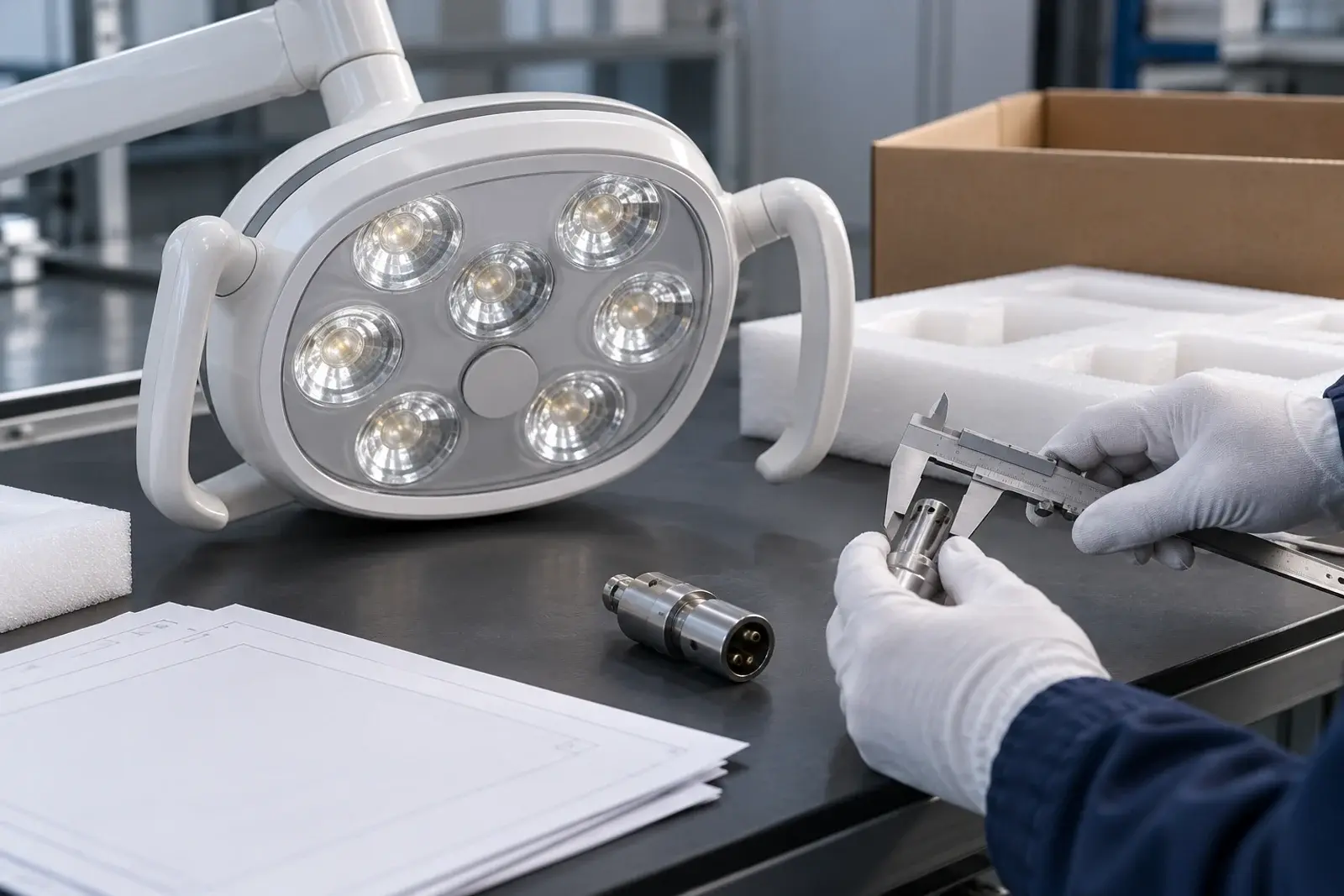
The buying decision, clearly stated.
A useful OEM RFQ identifies the buyer's platform, intended use, lamp configuration, four interfaces, destination, evidence needs and sample acceptance gates. Separate requested changes from confirmed feasibility. Approve a uniquely identified sample and its document revisions, then require a review of changes that could affect the accepted configuration before production release.
- An RFQ should contain enough information to expose unknowns, not hide them behind custom wording.
- Commercial confirmation and technical sample approval are related but separate decisions.
- A golden sample is useful only when later deliveries can be traced to its configuration.
Write the project brief before asking for a custom quotation
Start with the job: the chair platform or mounting installation, operator tasks, intended use, target destination and party responsible for final assembly. Then identify whether the request concerns a standard head, a configured mounting assembly or a genuinely new development question. Those scopes require different evidence and should not be merged into a single request for an OEM light.
Colight's catalogue includes standard lamp heads and configured dental hardware. That supports a discussion of project scope, not a promise that every proposed change is available. Keep the requested geometry, controls, appearance, cable and documentation changes in a list with status fields: requested, feasibility pending, confirmed or rejected. Do not issue sales material that presents a requested change as an existing specification.
Separate technical feasibility, samples and commercial terms
Ask the supplier to distinguish what can be quoted now from what needs drawings, engineering review or a sample. The response should identify assumptions, deliverables, exclusions and decisions required from the buyer. A quotation for a lamp head is not automatically a quotation for the supply, arm, installation hardware or destination compliance work.
Record quantities, destination, packaging scope, labelling responsibilities and any requested delivery window. Pricing, MOQ, development charges, sample charges, warranty and lead time need explicit commercial confirmation. This guide supplies no standard numbers for those fields. A target date in a buyer's brief is not a supplier commitment, and a sample schedule is not necessarily a production schedule.
Define what the sample must demonstrate
Prepare acceptance questions for interfaces, operator controls, positioning, documentation, appearance and agreed inspection evidence. Use a named responsible person for each decision. Record the sample identifier, model, configuration, drawing revision, supplied accessories, instructions and evaluation conditions. Keep observations separate from formally measured or certified results.
Industry product information increasingly shows how lighting connects to broader dental-unit workflows. Planmeca's integrated camera light is one example of configuration-dependent functionality, not a Colight feature claim. Use that context to ask whether the buyer requires independent controls, chair integration or a separate system. Any desired interoperability remains a requirement until the responsible parties confirm it.
Evidence context: Planmeca
Freeze the accepted configuration, not just the sample's appearance
An accepted sample should point to a controlled record that can be used for repeat orders. Include the defined configuration, approved documents, inspection criteria, packaging and labelling version where applicable. State which unresolved issues block release and which are accepted limitations. Do not use a signature on a photograph as a substitute for the missing engineering fields.
Before later substitutions or design changes, assess what acceptance evidence is affected. A change to a cable, connector, control module, arm, head or instruction may require a focused review rather than a full restart, but that decision must be deliberate. ISO 9680's current edition is a document-review question where relevant, not proof that a sample or customization has been tested against it.
Evidence context: ISO
An appearance-led sample versus a controlled sample
The approval method determines whether the sample can support a repeatable order.
Looks like the requested light
- Useful for
- Useful for discussing visible form and finish at an early stage.
- Check carefully
- Does not establish interfaces, included functions, evidence or repeat-order identity.
- Decision context
- Concept discussion before technical feasibility and formal approval.
Identified sample and specification record
- Useful for
- Connects observations, documents and ordered options to one accepted configuration.
- Check carefully
- Requires maintained revisions and an agreed process for later changes.
- Decision context
- A production decision that needs traceability and clear responsibilities.
Put the evidence beside the decision.
| RFQ field | Information to supply | Decision owner |
|---|---|---|
| Project and intended use | Platform, task, installation scope and destination | Buyer project lead |
| Candidate configuration | Model, options and separately listed requested changes | Buyer and supplier technical teams |
| Four interfaces | Supply, mechanical engagement, cable route and controls | Responsible integration engineer |
| Evidence and instructions | Required document types, language and applicability | Buyer quality or regulatory reviewer |
| Sample acceptance | Evaluation conditions, approval criteria and unresolved holds | Named evaluators |
| Commercial and delivery | Quantity, destination, packaging and target dates for confirmation | Purchasing and supplier sales |
| Production release | Accepted revisions, inspection record and change notification | Authorized project owners |
RFQ to controlled repeat order
- 01
Submit the brief
Provide the platform, task, destination and known constraints.
- 02
Resolve feasibility
Separate standard options, engineering questions and exclusions.
- 03
Agree the sample
Confirm deliverables and evaluation responsibilities before review.
- 04
Freeze the record
Connect acceptance to model, options, drawings and instructions.
- 05
Release with change control
Keep repeat deliveries and substitutions tied to the accepted configuration.
Worked example: a connector change after sample approval
A hypothetical OEM approves a lamp sample for a chair platform, then requests a different connector on the production order. The earlier approval cannot silently cover the new mating geometry. The change record identifies affected drawings, retention, cable routing and any additional installation evidence. The supplier confirms feasibility and the responsible engineering team decides which checks must be repeated.
If only an appearance detail changes, a narrower review may be appropriate, but the record still needs the revised identity. If the supply or mounting scope changes, the review may be wider. The useful result is a documented reason for the release decision, rather than an unqualified statement that the original golden sample covers everything. Commercial timing is reconfirmed if the change affects deliverables.
Questions buyers ask next.
Does OEM mean any modification is available?
No. Requested changes need feasibility review and an agreed scope. Identify each change separately and obtain confirmation before presenting it as a supplied feature.
What makes a golden sample traceable?
Its identifier should connect to the model, configuration, drawings, instructions, evaluation conditions, acceptance decisions and applicable packaging or labelling versions. A physical sample without that record is difficult to use for repeat-order control.
Can this guide supply a standard MOQ or lead time?
No. MOQ, price, charges, warranty and delivery depend on the confirmed scope and commercial agreement. Send the project details for an explicit quotation rather than assuming site-wide terms.
Does the website RFQ form confirm an order?
No. An enquiry is not an order, feasibility approval or delivery commitment. Confirm the working contact route and obtain an explicit supplier response for the project; the site's form-delivery setup remains a separate operational matter.
Follow the evidence.
Manufacturer and institutional sources inform the context. Colight specifications come from the verified site catalogue; competitor values are not presented as Colight test results. References were checked on 2026-10-27.
- ISO 9680:2026 — Dentistry: Operating lights
Edition and scope reference; the full standard is not reproduced. Publication: May 2026. Checked October 27, 2026.
- Planmeca Solanna Vision — operating light and camera integration
Industry reference for integrated camera and dental-unit workflows; these features are not attributed to Colight. Checked October 27, 2026.
Corrections or missing project evidence: contact Colight. The page supports purchasing discussions and does not provide patient-specific care, electrical installation instructions or a legal market-access decision.